Where are farmland birds disappearing in Europe: providing regular and frequent maps from European monitoring data
April 15, 2026 | Marina Kipson
As Europe’s landscapes continue to change, many farmland birds — once widespread and familiar — are quietly vanishing. Identifying where these declines occur, how rapidly, and why is vital for protecting biodiversity and guiding effective environmental policies. A recent scientific study, utilising data collected through the EBCC network and published in Conservation Biology, offers a valuable new tool: the ability to generate regular, high‑resolution maps illustrating changes in the probability of farmland bird occurrences across Europe.
Why maps matter?
„Knowledge of species distributions is essential for informing policies on nature conservation and restoration. However, updating them regularly and harmonising this at the international level is challenging. Here at the European Bird Census Council, we took initial steps for this through the EBBA Live project, where we used Pan-European Common Bird Monitoring Scheme (PECBMS) data covering five years to update farmland bird species distributions and assessed how they changed compared to the previous five-year period on both continental and regional scales,“ said Sergi Herrando, EBCC chair and researcher at CREAF/ICO, one of the lead authors of the study.
The study used standardised national monitoring data collated through PECBMS for 50 European farmland bird species, between 2018 and 2022, to produce 10×10 km maps indicating the probability that each species occurs in a given area. Additionally, it created models for the previous five years (2013-2017) and visualised differences in the probability of occurrence per 10×10 km area between both periods as calibrated change maps, highlighting areas where species are increasing, stable, or declining.
What do the maps tell us?
„We were able to get reliable change estimates for 43 species, and distribution changes were positively correlated with independent abundance trends. Unfortunately, our results show that predicted occurrences declined for 33 species, increased for only 9, and remained unchanged for 1. For most species, the direction of change in distribution was consistent with changes in the species’ overall abundance during the same period, except for four species,“ added Alena Klvaňová, co-author and PECBMS project manager based at CSO.
These 43 species collectively lost, on average, 0.79% of their distribution across Europe between 2013–2017 and 2018–2022. Some species experienced more than a 2% loss in distribution, which is significant given the short timeframe analysed. The two species with the largest losses were the black-eared wheatear (average lost 3.7%) and the woodchat shrike (average lost 2.3%), whereas the greatest gains were for the lesser kestrel (average increase 1.4%) and the Spanish sparrow (average increase 1.1%).
Four example species, four different stories
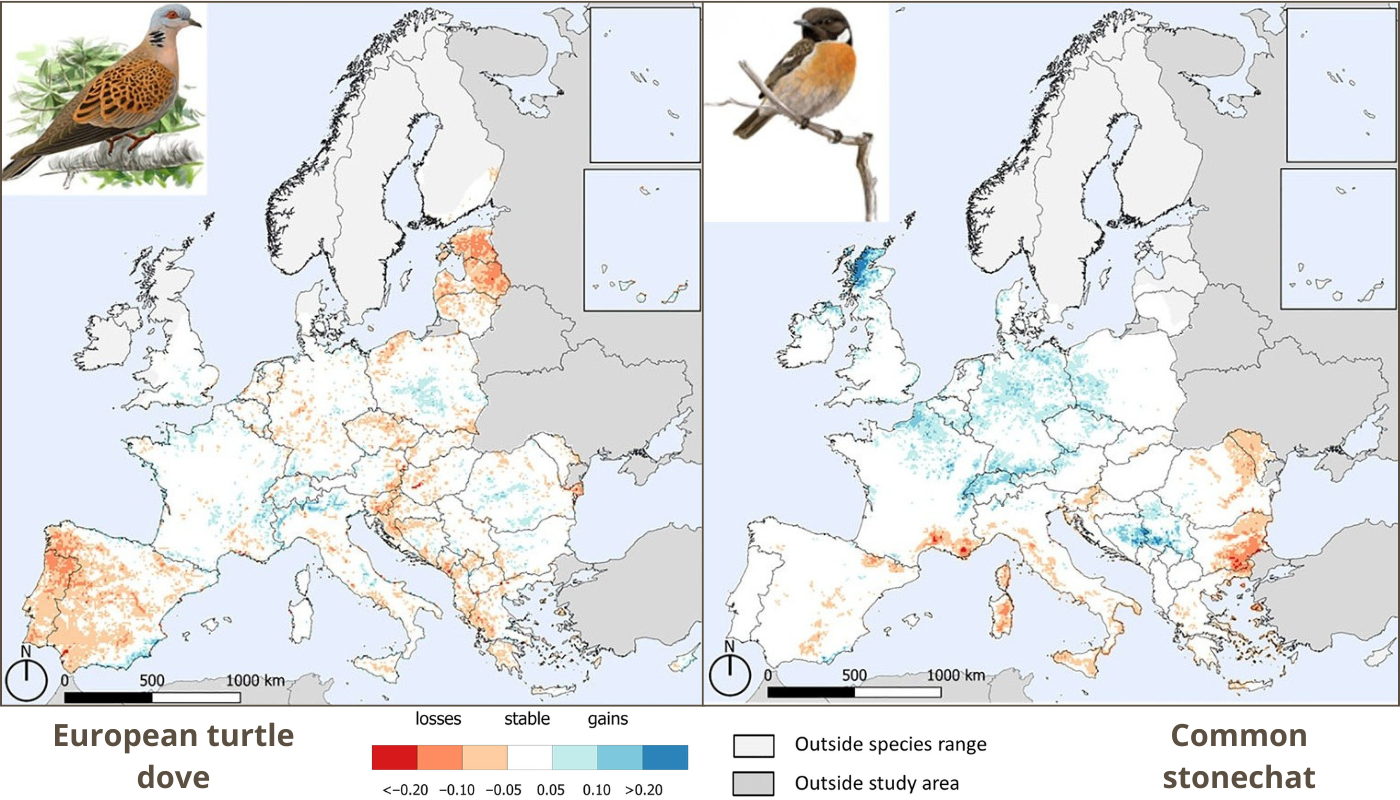
„We selected four species (European turtle-dove, common stonechat, Eurasian tree sparrow, common linnet) as examples because of their widespread and complementary distribution patterns across Europe, and their contrasting occupancy changes, increasing in some regions while declining in others. Although the pattern of change was mostly negative in all four species, the magnitude and direction of change varied spatially, with some areas experiencing gains,“ mentions Klvaňová.
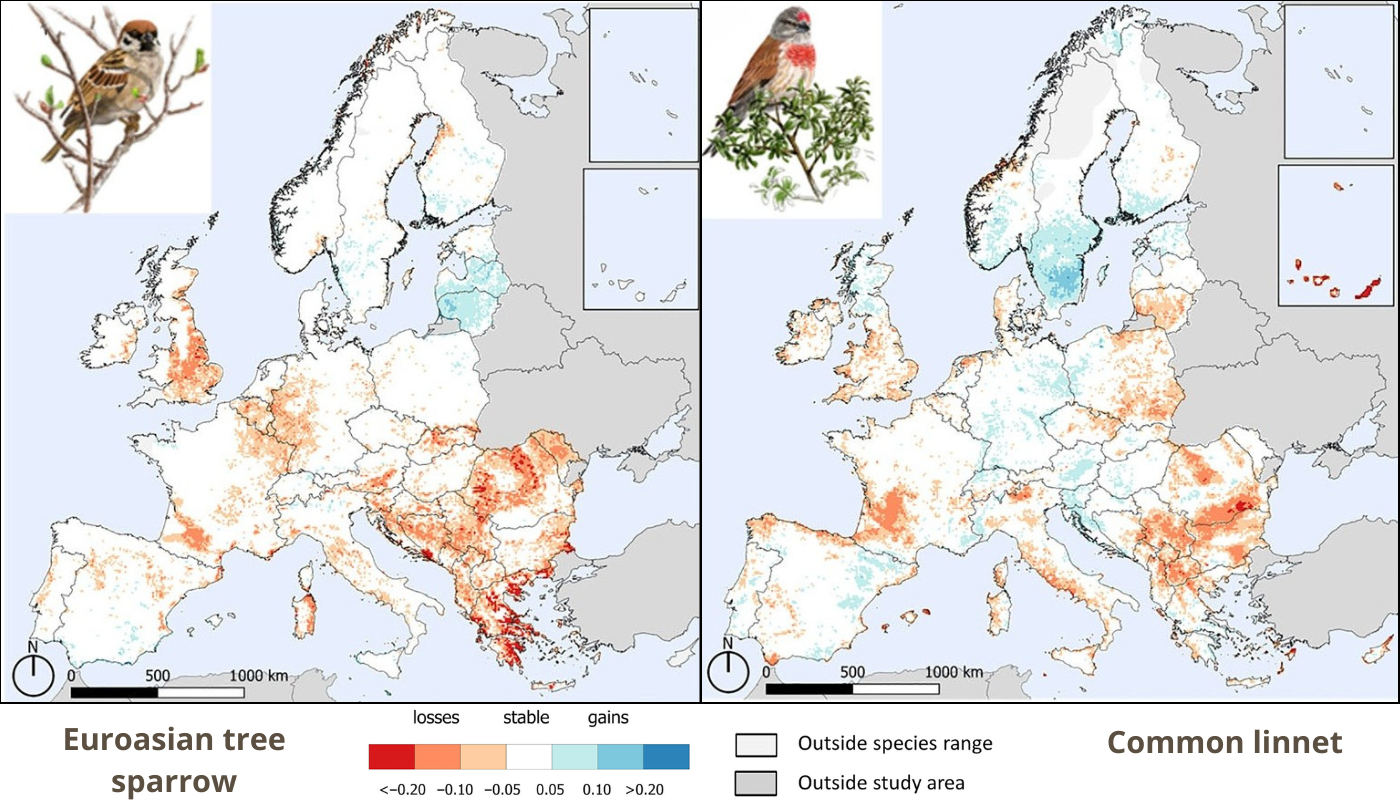
The European turtle-dove exemplified the overall decrease in distribution during the study period, with significant losses across most European regions. The common stonechat showed a slight overall gain but had contrasting positive and negative changes, with negative shifts concentrated in the southern regions where the species had the highest occurrences. Amid an overall trend of loss, the Eurasian tree sparrow displayed minor gains only in the central eastern and northern regions. Lastly, for the common linnet, losses mainly occurred in the south-western, central eastern, and south-eastern regions, while gains were concentrated in the north and west. Unlike the more uniform pattern of the previous species, these regions exhibited noticeable variation.
„Overall, our results indicate a recent contraction of farmland bird distributions in Europe, demonstrating the strong capacity of current bird monitoring schemes to provide continent-wide species maps that can be regularly updated. Tracking changes every few years could be used as an alert system to help improve policy reporting and enable early interventions through its spatially explicit approach, a novel feature in Europe. We hope our findings will enhance the targeting of conservation and restoration measures and guide the development of restoration plans,“ Herrando concludes.
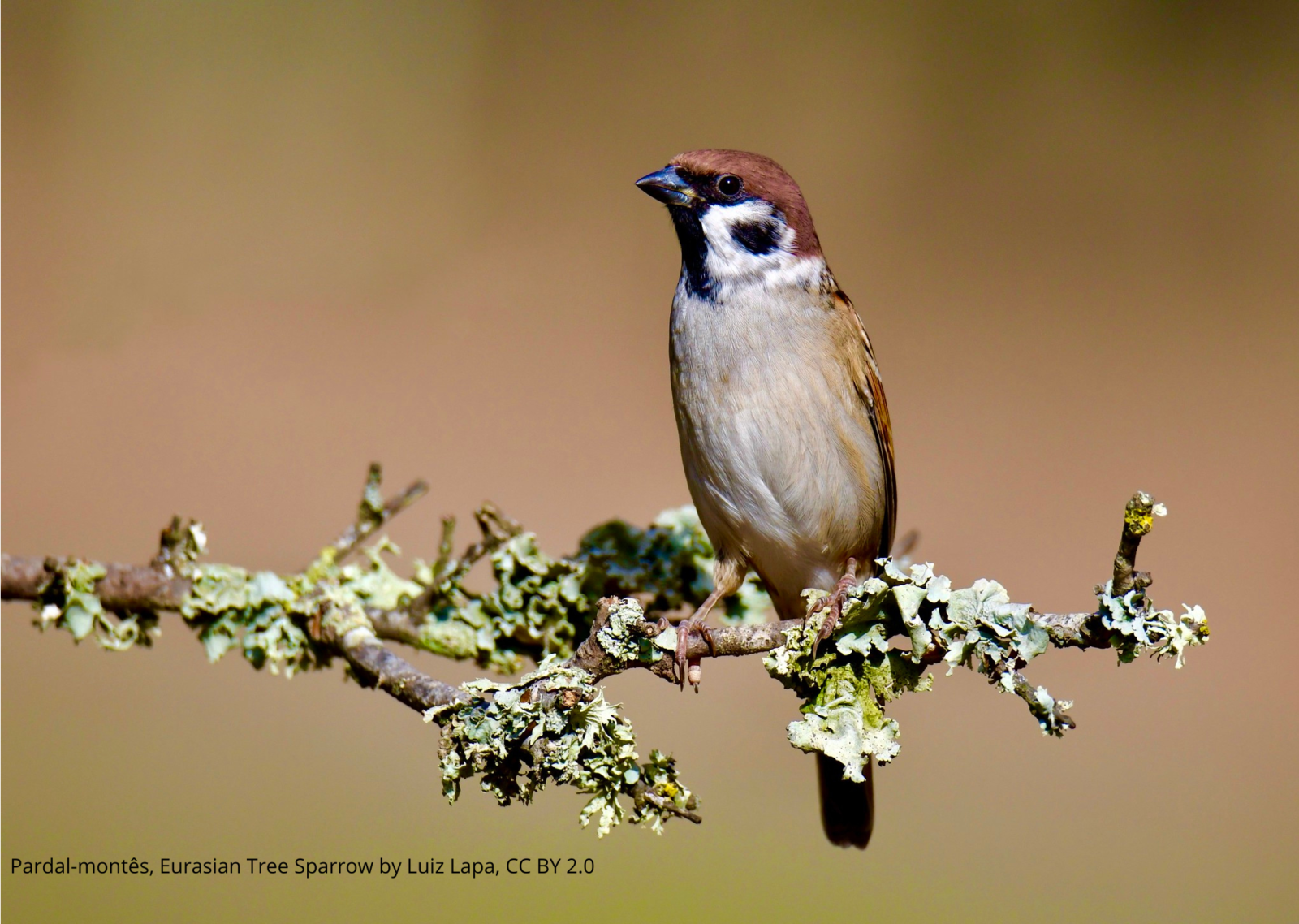
Introduction photo: Pardal-montês, Eurasian Tree Sparrow by Luiz Lapa, CC BY 2.0