Spatial autocorrelation of species diversity and distributions in time and across spatial scales
May 29, 2026 | Marina Kipson
The results of a new study show that spatial structure is a persistent and fundamental feature of biodiversity, but it depends strongly on scale, does not change uniformly over time, and varies across species and ecological contexts. This has important implications for conservation planning (e.g., identifying biodiversity hotspots), ecological modelling (where spatial dependence must be accounted for), and understanding how biodiversity responds to long-term environmental change.
The study, led by Carmen D. Soria of the Czech University of Life Sciences in Prague and published in the journal Global Ecology and Biogeography, examined spatial autocorrelation (SAC), the tendency for spatial aggregation or fragmentation of species diversity and distributions, and how it varies across space and time. Positive SAC indicates clusters of species presence or richness, while negative SAC indicates spatial dispersion.
The research aims to
1) assess whether species richness and distributions are spatially autocorrelated,
2) examine how SAC changes over time and across grain sizes,
3) explore the relationship between species-level temporal changes in occupancy and SAC, and
4) assess how species’ ecological traits (e.g., habitat type, dispersal ability) influence temporal changes in SAC.
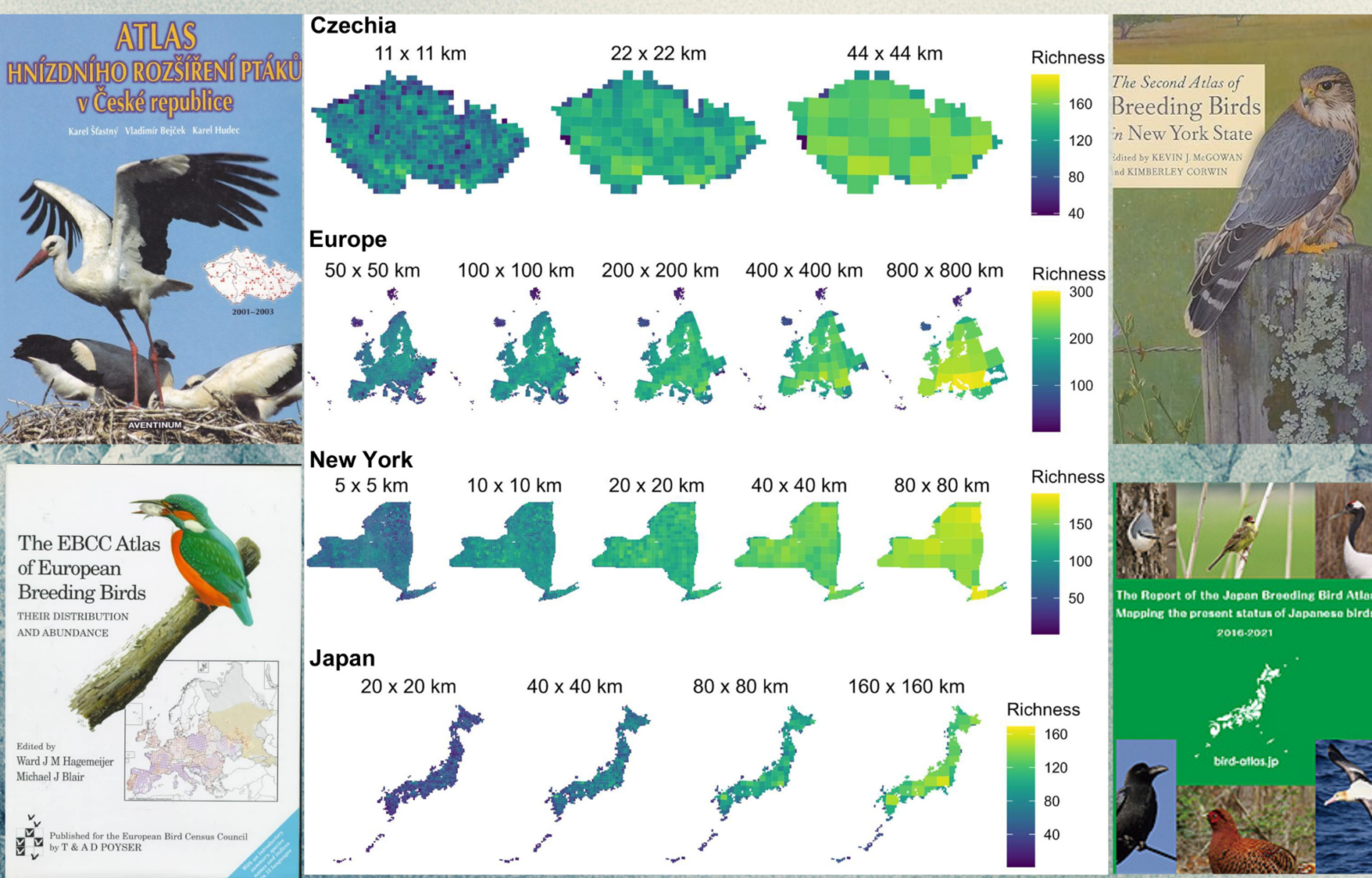
To examine these questions, the authors used a large, long-term biodiversity dataset focused on birds, one of the best-documented taxonomic groups. They analysed datasets from four bird atlases, each repeated over time. The study covered breeding bird atlases from Czechia, Europe, New York State, and Japan from 1972 to 2017. The regions aimed to capture diverse geographical areas in the Northern Hemisphere, species pools, time periods, survey durations, spatial extents and grain sizes.
Key Findings and Conclusions
- Species patterns are consistently clustered
Species richness showed positive spatial autocorrelation across all regions and time periods, and most species distributions showed the same pattern. This confirms that biodiversity is not randomly distributed but tends to form clusters or “patches”.
- Scale matters
Spatial clustering is indeed a ubiquitous feature of distributions, and the strength of species SAC decreases at larger grain sizes. This decreasing trend likely reflects the loss of finer-scale spatial structure as species presences and richness become aggregated over larger sampling units. Coarser grains encompass a wider range of habitats, which can dilute SAC by averaging across diverse environments and reducing spatial differentiation.
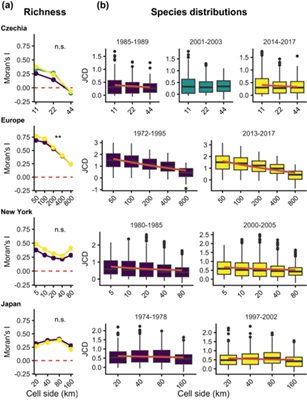
Empirical change in SAC of species richness and distributions with increasing grain size.
- No universal temporal trend
Despite environmental changes over the decades, there was no significant effect on SAC over time. In other words, the distributions of species with higher dispersal ability are not becoming patchier over time. This may reflect a spatiotemporal scale mismatch: many species are likely able to disperse over non-adjacent cells over the time period examined, and habitat patchiness or autocorrelated climate may thus have a stronger influence on range aggregation.
- Species traits played a marginal role
Factors such as habitat preference or dispersal ability influenced SAC changes in some cases, but did not produce a single universal pattern. SAC trait associations were weak, underscoring the generally observed limited explanatory power of traits for large-scale spatiotemporal changes in biodiversity.
Full paper available at: Soria, C. D., G. R.Ortega-Solís, F. J. R.Wölke, et al. 2026. “Spatial Autocorrelation of Species Diversity and Distributions in Time and Across Spatial Scales.” Global Ecology and Biogeography35, no. 3: e70221. https://doi.org/10.1111/geb.70221.