Using EBBA2 data in continent-wide prioritization of protected areas
September 7, 2026 | Marina Kipson
The results of a new study using data from the 2nd European Breeding Bird Atlas show that selecting 30% of Europe’s highest-priority terrestrial areas would protect 49% of species’ ranges and 63% of species’ populations. This has important implications for conservation planning by identifying biodiversity hotspots and key prioritisation areas at the European level.
The study examined prioritisation of the protected area network in Europe to meet the EU and global biodiversity (30×30) targets – protect 30% of the areas in both terrestrial and aquatic ecosystems.
The research questions were
- How do conservation priorities for European breeding birds differ when based on abundance rather than on occurrence in a complementarity-based optimisation framework?
- How do conservation priorities for European breeding birds differ when 30% targets are prioritised to fill only continental-scale targets or both national- and continental-scale targets?
- How do separate habitat-specific prioritizations for six major habitat groups compare with an overall full-species prioritisation in terms of spatial patterns and efficiency of population coverage?
- How well do existing networks of protected areas and IBAs capture the priorities identified by abundance-based and habitat-specific prioritizations?
To examine these questions, researches used European Breeding Bird Atlas 2 data from the years 2013–2017, which includes both occurrence and relative abundance information for all species. The study included 435 bird species, excluding non-natives and vagrants. The analyses were conducted using the prioritisation program Zonation.
Key Findings and Conclusions
-
-
- Abundance data improves prioritisation
-
Prioritisation based on abundance maps would increase species’ population coverage. Prioritisation based on occurrence maps, rather than abundance maps, was less efficient at covering both the ranges and populations of species with limited ranges and lower abundances.
-
-
- National and European prioritisation areas differ
-
The national prioritisation approach resulted in more uniform coverage of priority areas than the continental prioritisation approach, which showed northern and southern sites with higher priority ranks. This is because northern and southern areas have more species with limited ranges. However, national prioritisation has many benefits, including that protection decisions are made on a national scale.
-
-
- Priority areas differ widely depending on habitat type
-
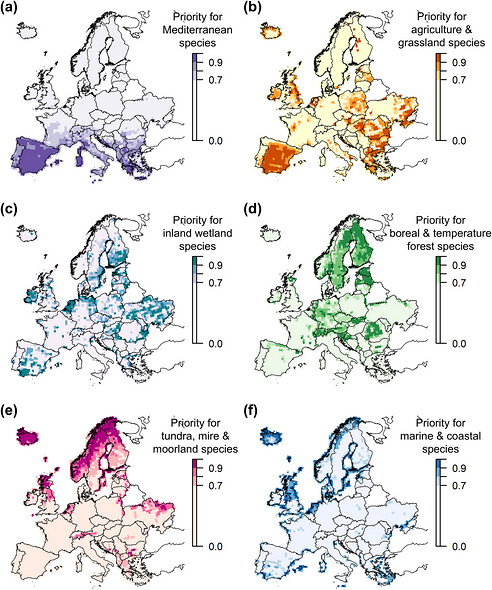
Priority areas differed substantially among the six habitat types, following known differences in regional distributions for major bird groups in Europe. Habitat-specific prioritisation better accounted for regional differences in biodiversity values.
-
-
- Protected area coverage differs widely between countries
-
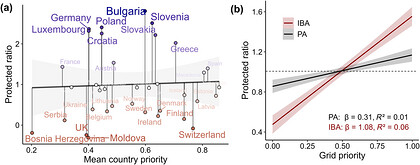
The current network of protected areas covers 24% of the 41 studied countries in Europe, with clear variation between countries. Neither the protected ratio nor the Important Bird and Biodiversity Areas (IBA) coverage ratio per country was significantly associated with its mean priority rank. The strong spatial correspondence between IBAs and high-priority areas suggests that IBAs represent efficient candidates for strengthened protected area coverage.
Yanjie Xu and Aleksi Lehikoinen led the study at the Finnish Museum of Natural History, University of Helsinki, and it was part of the larger EU-funded Biodiversa consortium SPEAR. The article was published in the journal Conservation Biology.
Full paper available at: Xu, Y., Pavon-Jordan, D., Hallman, T., Bakx, T. Brotons, L., Herrando, S., Johnston, A., Sandercock, B., Sattler, T., Soultan, A., Ajder, V., Balmer, D., Burke, B., Cavalcante, T., Chodkiewicz, T., Foppen, R., Fox, A., Keller, V., Kornienko, T., Knaus, P., Kujala, H., Lindström, Å., Maxhuni, Q., Nagy, K. Øien, I. J., Part, T., Radišić, D., Rajković, D., Ramirez, I., Shimmings, P., Šťastný, K., Vikstrom, T., Wilk, T., Lehikoinen, A. 2026: Continental-wide prioritization of protected areas to approach global and habitat-specific goals for avian biodiversity conservation. — Conservation Biology (online early): e70324