EBCC Statement on the role of the Farmland Bird Indicator (FBI) in Common Agricultural Policy (CAP)
April 23, 2026 | Marina Kipson
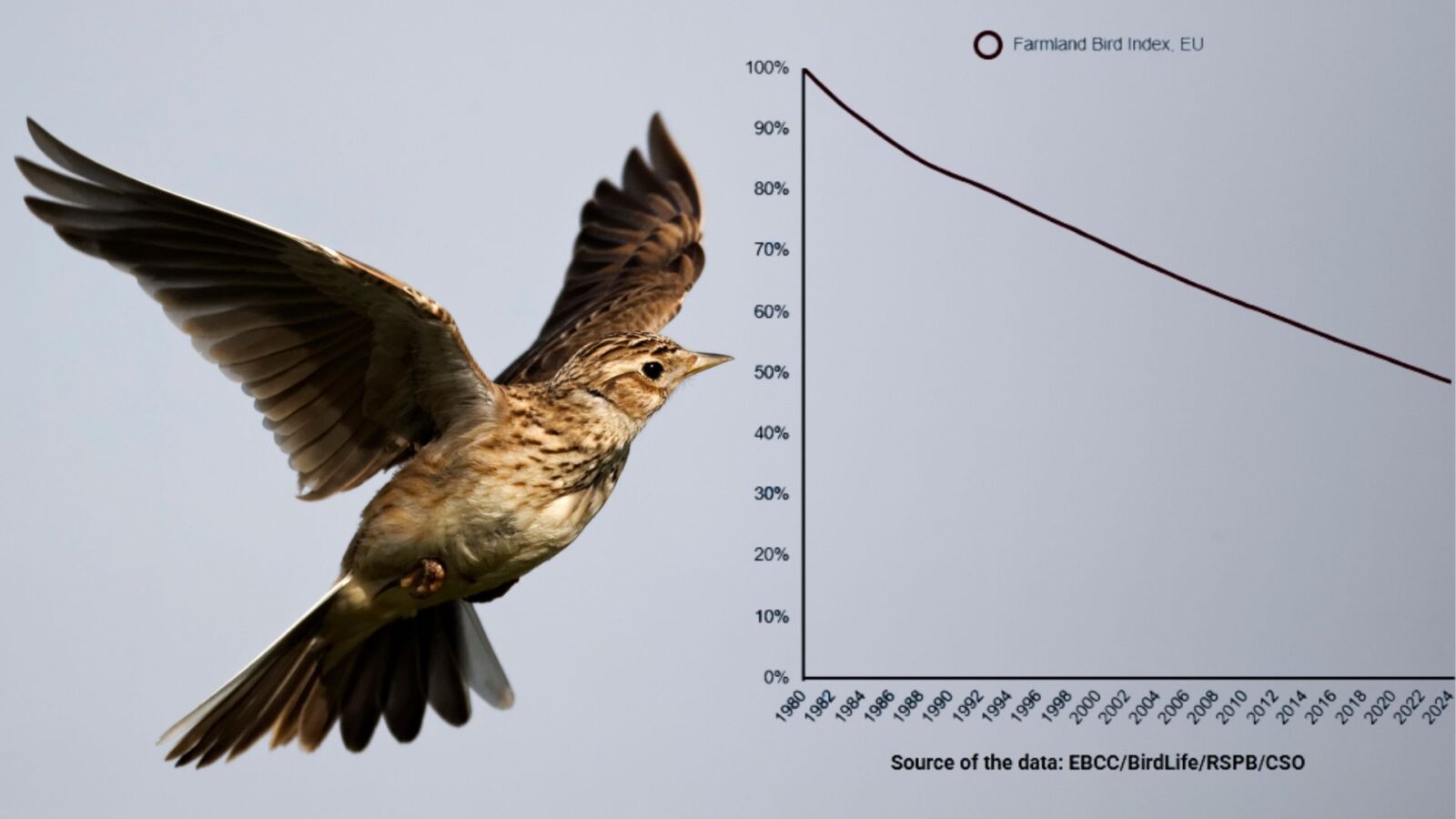
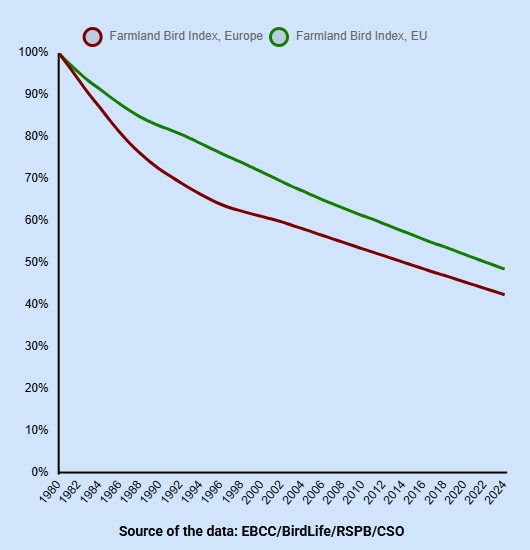
The Farmland Bird Indicator (FBI) has been one of the few indicators relevant to biodiversity within the EU Common Agricultural Policy (CAP). It is the most robust biodiversity indicators used by Eurostat. The indicator shows the performance of common bird species characteristic for farmland and thus informs on how the overall biodiversity in farmland performs.
The EBCC wishes to express its concern on the potential removal of biodiversity indicators post-2027 CAP and EU budget performance framework.
We consider that the FBI is an important element for assessment of environmental measures within CAP, particularly in situation where other biodiversity indices are not present in the set of the indicators. In addition, the FBI could be one of few fully operational biodiversity indicators in Policy areas (level 2) number 12 (“Support for environment and climate practices, including climate resilience measures”), 13 (“Support for environment and climate transition, including climate resilience measures”, see COM (2025) 545, in its Annex 1). FBI can be calculated at national and EU levels and provides information about overall effect of interventions for biodiversity. It can be done at a low cost because data collection is largely based on skilled citizen scientists, and long-time series are already available for reporting on progress.
EBCC recommends the FBI remains among the CAP biodiversity indicators as this is one of the most scientifically robust and cost-effective ways to measure a performance of CAP in its environmental goals.
Technical information on the FBI
Birds as indicators of biodiversity
Birds are good indicators of biodiversity because they respond quickly to environmental changes. Bird populations change rapidly when habitats are disturbed, making them early warning signs of ecosystem health. Birds occupy many trophic levels – from seed-eaters to top predators, therefore reflect conditions across the food web. Birds are also widespread and easy to monitor, live in almost every habitat and are easier to observe than many other species. They depend on diverse habitats – healthy bird communities usually mean healthy plant life, insects, and other wildlife (6, 7).
What is Farmland Bird Indicator and how to interpret it
Farmland Bird Indicator is a multi-species population index based on data from monitoring of breeding bird populations in EU Member States (and beyond). The indicator is calculated using widely used an indicator tool (MSI tool) developed in Statistics Netherlands (13). The tool produces the index and also the smoothed values with confidence intervals and the trend of the indicator.
If the indicator goes up, this is a signal that the bird community is doing well. If it goes down, the bird community is suffering a loss. If it remained stable, we have no evidence that the abundance of the group as a whole has changed (6).
How it is produced and by whom
The indicator is based on relative population indices of individual species. The underlying data on bird abundances come from national or regional bird monitoring schemes (breeding bird surveys). The data are representative for Member States as the schemes use standardised monitoring methods (1).
Skilled fieldworkers, usually volunteers, perform the counts ensuring long-term sustainability and high quality of the data. National population indices are calculated by state of the art methods developed and constantly improved in Statistics Netherlands (1). The national population indices are further used for calculation of European supra-national indices and indicators within the EBCC programme Pan-European Common Bird Monitoring Scheme (1).
How the quality and scientific relevance is achieved
Coordinators of the national schemes are members of the network of cooperating organisations within European Bird Census Council (EBCC), who oversees the programme ensuring high scientific quality of methods and outputs.
The methods for monitoring birds are standardised scientific methods. The collected count data are regularly checked by the national coordinators to ensure they provide a reliable picture of population change in the countries. The PECBMS coordination unit controls and oversees the national data quality too. Next to the calculation of indices and indicators, the data are also used for numerous research studies. Such studies have been published in high profile scientific peer-reviewed journals including studies of links between population trends of birds and agricultural policies (2, 3, 4, 5, 8, 9, 10, 11, 12, 14). The publication in peer-reviewed scientific journal is an independent proof of high scientific standards of the methods and data quality. The indicators produced by PECBMS have been also endorsed by Eurostat.
Obtain the full statement in pdf.
References
1. Brlík, V., Šilarová, E., Škorpilová, J., Alonso, H., Anton, M., Aunins, A., Benkö, Z., Biver, G., Busch, M., Chodkiewicz, T., Chylarecki, P., Coombes, D., de Carli, E., del Moral, J.C., Derouaux, A., Escandell, V., Eskildsen, D.P., Fontaine, B., Foppen, R.P.B., Gamero, A., Gregory, R.D., Harris, S., Herrando, S., Hristov, I., Husby, M., Ieronymidou, C., Jiguet, F., Kålås, J.A., Kamp, J., Kmecl, P., Kurlavičius, P., Lehikoinen, A., Lewis, L., Lindström, Å., Manolopoulos, A., Martí, D., Massimino, D., Moshøj, C., Nellis, R., Noble, D., Paquet, A., Paquet, J.-Y., Portolou, D., Ramírez, I., Redel, C., Reif, J., Ridzoň, J., Schmid, H., Seaman, B., Silva, L., Soldaat, L., Spasov, S., Staneva, A., Szép, T., Tellini Florenzano, G., Teufelbauer, N., Trautmann, S., van der Meij, T., van Strien, A., van Turnhout, C., Vermeersch, G., Vermouzek, Z., Vikstrøm, T., Voříšek, P., Weiserbs, A., Klvaňová, A. (2021): Long-term and large-scale multispecies dataset tracking population changes of common European breeding birds. Scientific Data 8: 21.
2. Butler, S.J., Boccaccio, L., Gregory, R.D., Vorisek, P., Norris, K. (2010): Quantifying the impact of land-use change to European farmland bird populations. Agriculture, Ecosystems and Environment 137: 348-357.
3. Carboneras, C., Šilarová, E., Škorpilová, J., Arroyo, B. (2024): Rapid population response to a hunting ban in a previously overharvested, threatened landbird. Conservation Letters 17 (6): e13057.
4. Gamero, A., et al. (2017): Tracking progress toward EU Biodiversity Strategy targets: EU policy effects in preserving its common farmland birds. Conservation Letters 10: e12292.
5. Gregory, R.D., Škorpilová, J., Voříšek, P., Butler, S. (2019): An analysis of trends, uncertainty, and species selection shows contrasting trends of widespread forest and farmland birds in Europe. Ecological Indicators 103: 676-687.
6. Gregory, R.D., van Strien, A.J., Vorisek, P., Gmelig Meyling, A.W., Noble, D.G., Foppen, R.P.B., Gibbons, D.W. (2005): Developing indicators for European birds. Philosophical Transactions of the Royal Society B 360: 269-288.
7. Gregory, R.D., van Strien, A. (2010): Wild bird indicators: using composite population trends of birds as measures of environmental health. Ornithological Science 9 (1): 3-22.
8. Gregory, R.D., Vorisek, P., Noble, D.G., van Strien, A., Klvaňová, A., Eaton, M., Gmelig Meyling, A.W., Joys, A., Foppen, R.P.B., Burfield, I.J. (2008): The generation and use of bird population indicators in Europe. Bird Conservation International 18: S223-S244.
9. Morrison, C.A., Butler, S.J., Robinson, R.A., Clark, J.A., Arizaga, J., Aunins, A., Baltà, O., Cepák, J., Chodkiewicz, T., Escandell, V., Foppen, R.P.B., Gregory, R.D., Husby, M., Jiguet, F., Kålås, J.A., Lehikoinen, A., Lindström, Å., Moshøj, C.M., Nagy, K., Leal Nebot, A., Piha, M., Reif, J., Sattler, T., Škorpilová, J., Szép, T., Teufelbauer, N., Thorup, K., van Turnhout, C., Wenninger, T., Gill, J.A. (2021): Covariation in population trends and demography reveals targets for conservation action. Proceedings of the Royal Society B 288: 20202955.
10. Pellissier, V., Schmucki, R., Pe’er, G., Aunins, A., Brereton, T.M., Brotons, L., Carnicer, J., Chodkiewicz, T., Chylarecki, P., del Moral, J.C., Escandell, V., Evans, D., Foppen, R., Harpke, A., Heliölä, J., Herrando, S., Kuussaari, M., Kühn, E., Lehikoinen, A., Lindström, Å., Moshøj, C.M., Musche, M., Noble, D., Oliver, T.H., Reif, J., Richard, D., Roy, D.B., Schweiger, O., Settele, J., Stefanescu, C., Teufelbauer, N., Touroult, J., Trautmann, S., van Strien, A.J., van Swaay, C.A.M., van Turnhout, C., Vermouzek, Z., Voříšek, P., Jiguet, F., Julliard, R. (2020): Effects of Natura 2000 on nontarget bird and butterfly species based on citizen science data. Conservation Biology 34: 666-676.
11. Reif, J., Gamero, A., Hološková, A., Aunins, A., Chodkiewicz, T., Hristov, I., Kurlavičius, P., Leivits, M., Szép, T., Voříšek, P. (2024): Accelerated farmland bird population declines in European countries after their recent EU accession. Science of the Total Environment 946: 174281.
12. Rigal, S., Dakos, V., Alonso, H., Auniņš, A., Benkő, Z., Brotons, L., Chodkiewicz, T., Chylarecki, P., de Carli, E., del Moral, J.C., Domșa, C., Escandell, V., Fontaine, B., Foppen, R., Gregory, R., Harris, S., Herrando, S., Husby, M., Ieronymidou, C., Jiguet, F., Kennedy, J., Klvaňová, A., Kmecl, P., Kuczyński, L., Kurlavičius, P., Kålås, J.A., Lehikoinen, A., Lindström, Å., Lorrillière, R., Moshøj, C., Nellis, R., Noble, D., Palm Eskildsen, D., Paquet, J.-Y., Pelissié, M., Pladevall, C., Portolou, D., Reif, J., Schmid, H., Seaman, B., Szabó, Z.D., Szép, T., Tellini Florenzano, G., Teufelbauer, N., Trautmann, S., van Turnhout, C., Vermouzek, Z., Vikstrøm, T., Voříšek, P., Weiserbs, A., Devictor, V. (2023): Farmland practices are driving bird population decline across Europe. Proceedings of the National Academy of Sciences 120: e2216573120.
13. Soldaat, L.L., Pannekoek, J., Verweij, R.J.T., van Turnhout, C.A.M., van Strien, A.J. (2017): A Monte Carlo method to account for sampling error in multi-species indicators. Ecological Indicators 81: 340-347.
14. Stephens, P.A., Mason, L.R., Green, R.E., Gregory, R.D., Sauer, J.R., Alison, J., Aunins, A., Brotons, L., Butchart, S.H.M., Campedelli, T., Chodkiewicz, T., Chylarecki, P., Crowe, O., Elts, J., Escandell, V., Foppen, R.P.B., Heldbjerg, H., Herrando, S., Husby, M., Jiguet, F., Lehikoinen, A., Lindström, Å., Noble, D.G., Paquet, J.-Y., Reif, J., Sattler, T., Szép, T., Teufelbauer, N., Trautmann, S., van Strien, A.J., van Turnhout, C.A.M., Vorisek, P., Willis, S.G. (2016): Consistent response of bird populations to climate change on two continents. Science 352: 84-87.